



With the rapid development and large-scale deployment of FTTH, the pace of “optical advancement and copper retrogression” and broadband acceleration has been increasing. As an important information infrastructure for the transformation of a digital society, fiber access networks have developed rapidly driven by the broadband strategy of each country. At the end of 2018, China’s broadband access users have exceeded 400 million, and 100 Mbps access has become popular in China. The popularity of broadband has greatly changed the way people live and work, and unleashed people’s imagination for more emerging services. Video service has become a basic fixed broadband service, replacing the VoIP service as an important revenue stream for operators, and stimulating the trial and deployment of 4K and 8K services. Yet, the high traffic feature of the video service has proposed new requirements for network architecture and equipment deployment, such as deploying equipment downward and gradually closer to users, Network cloudification and virtualization, smart home network, and fiber getting closer to users and gradually replacing copper. All these make all-fiber access a development trend.
During the process of fiber access network construction, small capacity OLTs are favored by large number of operators because of its compactness, lightweightness, strong environmental adaptability, and budget-friendly cost. Small capacity OLTs meet the trend of optical access node closer to users, diversified deployment scenario, higher bandwidth provisioning, and broader resources, as well as the requirements for economical and highly efficient network construction.
Ⅰ. Comparison between small capacity OLTs and large-and-middle capacity OLTs
In network construction, large capacity OLTs and small capacity OLTs should be selected according to the actual situation and the network construction mode.
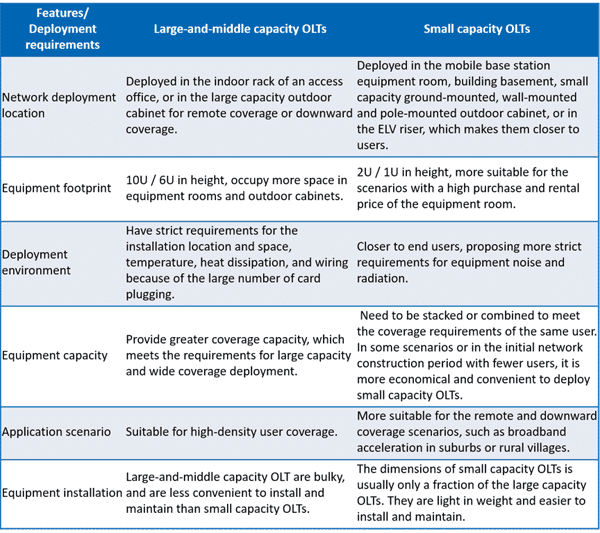
Table 1 Comparison between small capacity OLTs and large-and-middle capacity OLTs
With the advantages of more flexible deployment and stronger environmental applicability, small capacity OLTs are suitable for the scenarios such as limited room space, low-density area access, OLT remote and downward coverage, rapid access of smart industrial parks, and co-located OLT and mobile base station. At the same time, they provide more flexible uplink networking and protection capabilities to ensure service security and efficient service transmission.
Small capacity OLTs can be a 1U high pizza-box type box OLT, or a 2U high compact OLT. Box-type OLTs are generally a piece of fixed equipment with unpluggable line cards, and the cost is low; while 2U high OLTs generally provide carrier-grade protection as well as satisfactory power, fan, and main control card redundancy capabilities.
Ⅱ. Analysis of small capacity OLT application scenarios
The following section analyzes the small capacity OLT application scenarios. We divide them into the low-density area coverage, remote area coverage, asset-light operator application, smart industrial park, commercial building access, and FTTM scenarios.
- Low-density area coverage
Small capacity OLTs are more suitable for low-density areas because they can reduce the investments in infrastructures such as trunk fiber, duct and equipment room, power supply, and air conditioner, and can help operators reduce TCO. By using the optical module with a large optical power budget such as Class D optical module, small capacity OLTs can address long-distance user coverage. In addition, small capacity OLTs are an optimal solution for small-and-mid-sized operators because they reduce equipment room and auxiliary costs, suit harsh natural environments, and achieve rapid coverage of FTTH networks.
Figure 1 Low-density area coverage scenario
In these scenarios with a scarce number of users, small capacity OLTs can be flexibly deployed to reduce investments. - Remote area coverage
In some vast and sparsely-populated areas, network coverage confronts difficulties. The distance between the central node and the remote node is long, the line resources are scarce, and there are large amounts of intermediate nodes, connections, and complicated lines. Deploying small capacity OLTs downward is a cost-effective solution that covers more users and requires lower costs.
In this case, a POP point is generally set up remotely, and a small capacity OLT is deployed outdoors to reduce equipment room and auxiliary costs. Multiple small capacity OLTs are aggregated to a large OLT or an aggregation switch in the central office. The small capacity OLTs are configured with a 10 km /40 km / 80 km optical module and are connected with via an Ethernet GE or 10GE interface, and use a high-density PON interface card to cover a large number of users, which is suitable for the scenarios where the remote end has a certain user scale and business potentials.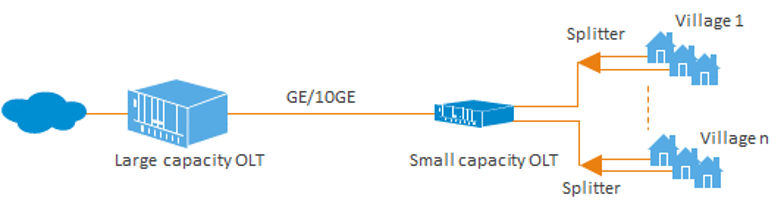
Figure 2 Remote area coverage scenario
In these scenarios where the users in rural areas are far away from the central office in the city, cascading networking of small capacity OLTs and small capacity OLTs can provide broadband access to rural places. - Asset-light operator applications
At present, some mobile operators or the operators transitioning to government and enterprise business do not have their own fixed-line equipment room and fiber resources, but lease the resources from incumbent fixed-line operators to provide home broadband and dedicated enterprise services. Small capacity OLTs with a high performance-cost ratio are the premium choice for cost-sensitive operators because small capacity OLTs occupy less footprint, consume less power, provide higher density per PON port, have lower requirements for equipment room space, indoor cabinet, power supply and air conditioner, reduce the investments in trunk fibers, ducts and equipment rooms, power supplies and air conditioners, and help reduce TCO.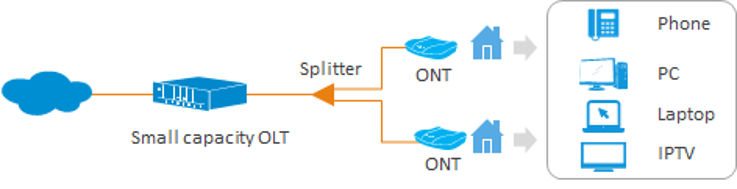
Figure 3 Asset-light operator application scenario
In these scenarios, the operators are sensitive to cost and have lower bandwidth demand; therefore, deploying small capacity OLTs can easily reduce initial investments and satisfy the operators’ requirements for rapid deployment and flexible scalability. - Smart industrial park and commercial building coverage
During the construction of industrial park networks in recent years, the POL (Passive Optical LAN) solution has increasingly become the operators’ first choice, and the construction of all-optical industrial park networks has become the consensus of the industry. Compared with the traditional Ethernet LAN, POL has the features of high security, low energy consumption, long distance, long service life, simplified network as well as centralized operation and maintenance. Based on the long-term investments and technical accumulation in developing PON access networks in the home broadband market, the operators are proactively promoting POL network construction. Compact and easy-to-install, small capacity OLTs meet the operators’ basic requirements for security and effortless maintenance, and provide cutting-edge technologies such as low-latency PON and 5G convergence, occupying an important position in the construction of POL networks.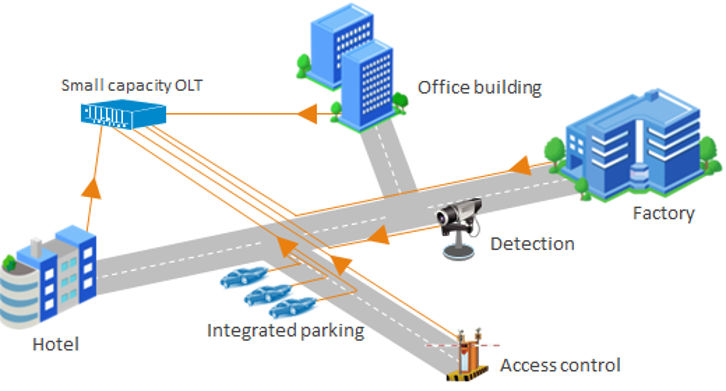
Figure 4 Smart industrial park and commercial building coverage scenario
The smart industrial park involves a variety of broadband access scenarios:
• Office Building: Enterprise POL
• Hotel: High-speed bandwidth access
• Factory: Industrial Internet
• Detection and parking access
Especially independent multi-tenant commercial buildings, each tenant needs dedicated broadband access to facilitate the enterprise independently rent an OLT, which is much safer.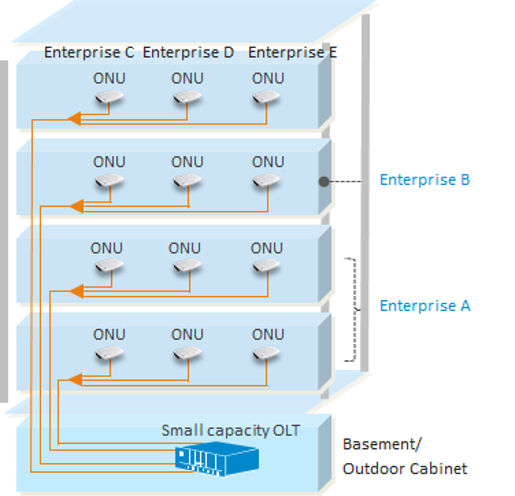
Figure 5 Independent multi-tenant commercial building scenario
In this scenario, small capacity OLTs can be deployed in the basement of a commercial building:
• Allocate an independent OLT to the enterprise users who occupy multiple floors.
• Allocate multiple PON ports to the enterprise users who occupy a single floor.
• Allocate multiple ONUs to multiple enterprise users on the same floor. - FMC scenarios
In the common fixed-mobile convergence (FMC) scenarios, mobile operators use existing backhaul network resources as well as equipment rooms and cabinets to build FTTH networks to transition from mobile operation to full-service operation. Small capacity OLTs can be co-sited and co-located and be deployed in the same cabinet with the base station to implement home network coverage through the deployment of short-distance drop fibers, achieve rapid deployment and service provisioning, and shorten the RoI.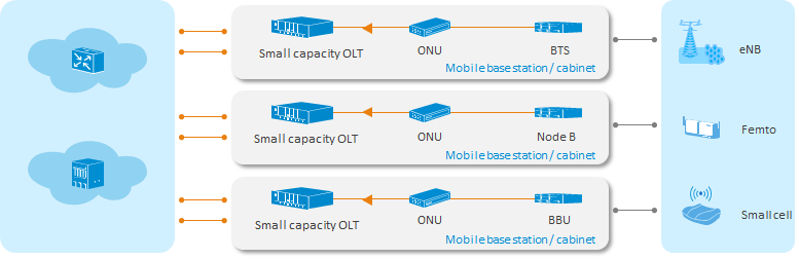
Figure 6 FMC scenarios I
Traditional mobile bearer networks often require a large amount of construction work, high investment, and long time. If the operators use the idle ports and optical fiber resources of the deployed FTTx network, the high-bandwidth channels provided by GPON and 10G PON, and the time and clock synchronization mechanism of the PON system to provide mobile bearing, the operators can improve the resource utilization of existing FTTx network. Small capacity OLTs have the features of small dimensions, flexible deployment, and low cost, and allow to share equipment room, rack and cabinet resources with mobile devices, hence reducing mobile network construction costs.
Figure 6 FMC scenarios II


