



Cellnex is Europe's largest telecommunications towers and infrastructures operator, enabling operators to access a wide network of telecommunications infrastructures on a shared-use basis, and thus helping to reduce access barriers and to improve services in the most remote areas.
The company manages a portfolio of more than 120,000 sites, including planned rollouts through 2030, across ten European countries: Spain, France, the United Kingdom, Italy, Poland, Portugal, Switzerland, the Netherlands, Sweden, and Denmark.
This year, Cellnex is placing the spotlight on real-world deployments already in operation across Europe. Through these examples, the company demonstrates how next-generation connectivity is reshaping critical sectors such as transport systems, emergency and public safety communications, energy-as-a-service solutions, high-capacity connectivity in venues and corporate environments, broadcasting, and the everyday services relied upon by millions of citizens.
During the Mobile World Congress in Barcelona we were invited to a mission-critical connectivity centre, where Cellnex showcased real-world applications demonstrating how how connectivity is increasingly tied to resilience, safety and efficient operation.
Emergency Management Centre of Catalunya (CECAT)
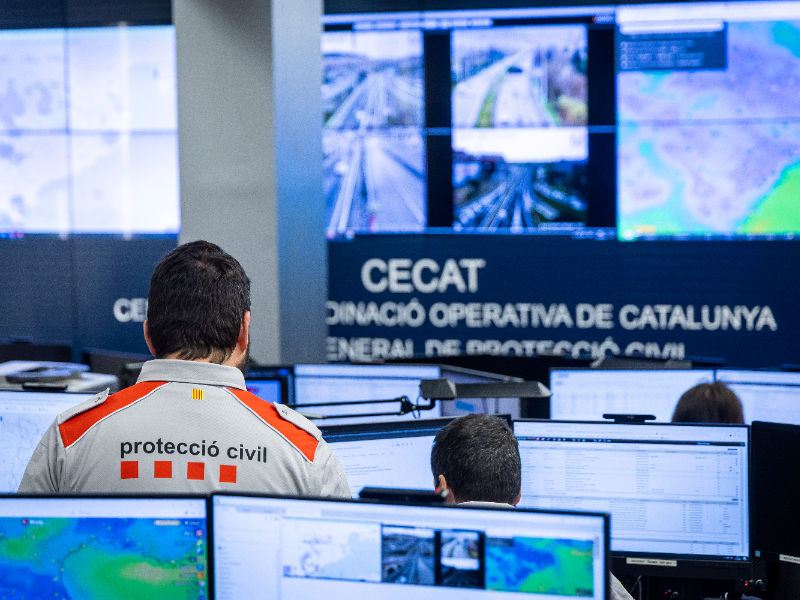
The Emergency Management Centre of Catalunya (CECAT) operates as a fully integrated, 24/7 facility across two locations—Barcelona and Reus—functioning as a single coordinated unit. Each site is staffed by teams with specialised technical and risk management expertise, including operators, control room managers, press liaisons, and supervisors.
Here, Cellnext demonstrates how its resilient networks support climate-related emergency services and continue to operate during power cuts.
Jaime Hayes, Group Sales Director at Cellnex, highlights the importance of the CECAT network, the critical communications system used by security and emergency services across Catalonia.
"What we have is a dedicated and resilient infrastructure designed specifically for public safety communications. CECAT provides secure and reliable communications for emergency and security forces, with a 99.9% availability level for public safety operations," says Hayes.
The network is designed to ensure full geographic coverage, sufficient capacity, and end-to-end operational management. It includes backup power systems that guarantee continuity during major incidents such as extreme weather events or power outages.
"This is a fully dedicated infrastructure, designed, deployed and maintained to ensure 100% geographic coverage and maximum resilience," Hayes adds.
The importance of Mission-Critical Communication Networks in times of crisis
Safety and emergency communication networks are vital infrastructures designed to deliver reliable, secure, and highly available communications for essential services. They enable real-time coordination between emergency teams, fleets, and authorities. Built with extensive coverage and redundancy, these networks remain operational even when conventional systems fail.
Recent events have demonstrated their importance.
One example is the general blackout of April 2025. During this large-scale outage, Cellnex’s mission-critical networks continued to operate, ensuring uninterrupted communication for emergency and essential services. At the same time, FM broadcasting—also provided by Cellnex—remained available to deliver information to the public.
Another example is the severe flooding in Valencia, one of the worst in decades. The disaster affected more than 70 municipalities and approximately 845,000 people. In this situation, the only fully operational network was the COMDES system, the regional emergency communications network based in Valencia. While other infrastructures failed or were disrupted, COMDES enabled emergency responders to coordinate rescue and relief efforts.
The role of Cellnex
As a neutral host infrastructure operator, Cellnex designs and operates telecommunications towers and networks built to withstand extreme conditions. These systems are engineered to remain operational during harsh weather, power outages, and periods of high demand.
At the core of the company’s approach is the management of critical and resilient infrastructure. Cellnex ensures uninterrupted service through robust redundancy measures, with sites equipped with uninterruptible power supply (UPS) systems, generators, and backup battery banks.
Reliable performance is further supported by operation and maintenance teams. Specialized staff oversee the infrastructure year-round, guaranteeing service availability 365 days a year.
In addition, Cellnex operates a 24/7 Network Operations Center (NOC), which continuously monitors network performance. This allows for detection of faults and rapid response to incidents, minimizing downtime and ensuring service continuity. During emergencies or natural disasters, Cellnex can also deploy mobile communication units to affected areas.
Currently, Cellnex Spain has more than 1,200 base stations deployed for mission-critical communications with more than c.97.000 active users through 19 regional and local private and dedicated networks.
Main functions
Modern emergency management systems play a central role in coordinating responses, sharing critical information, and protecting the public during crises. These platforms integrate multiple data sources and communication tools to support effective decision-making.
A key function is integration with emergency services such as 112, combined with real-time data from the Servei Meteorològic de Catalunya and Geographic Information Systems (GIS). These systems enable the registration and tracking of incidents from initial report through to resolution, while also supporting the management of emergency plans and coordinated response strategies.
A key capability is the secure dispatch of sensitive information to relevant authorities, ensuring that critical data reaches the right people without delay. At the same time, integrated GIS tools provide multiple data layers—such as risk zones, critical infrastructure, and the operational status of warning sirens.
Public warning and communication are also essential functions. The system allows for the activation of chemical risk sirens, the distribution of automated voice messages, and the sending of SMS alerts to vulnerable populations.
Marta Cassany, is the Director of Civil Protection within the Department of the Interior of the Government of Catalonia, and she emphasises the organisation’s dual mission: prevention and preparedness, alongside real-time emergency coordination.
"Civil Protection works continuously to prepare both the population and public systems for future emergencies, while also maintaining 24/7, year-round monitoring of everything happening across Catalonia. From the control room, teams coordinate the most appropriate response to reduce the impact of emergencies."
Cassany also underlines the importance of collaboration with the media to ensure that citizens receive accurate and timely information, stressing the important role of journalism in amplifying verified messages during crisis situations.
"The media are our key allies to ensure the population receives all the necessary information during an emergency," according to Cassany.


