



Voice over Wi-Fi (VoWiFi) is a technology that enables voice communication using a wireless internet connection rather than the mobile operator’s radio access network. First deployed in 2014, it’s particularly useful in areas with weak cellular coverage. It allows users to make and receive calls using their internet connection, thus improving call quality and reliability.
Author: Carsten Bock, Founder and Chief Innovation Officer at ng-voice
What is VoWiFi?
As with most next-generation voice services, VoWiFi operates by converting voice signals into data packets transmitted over IP networks. It applies codecs (compression-decompression algorithms) to ensure that voice quality is optimized and bandwidth is efficiently utilized. Unlike old-fashioned voice services carried over circuit-switched networks, VoWiFi and VoIP rely on packet-switched networks, enhancing network flexibility and resource management.
To use VoWiFi, users need a compatible smartphone and a Wi-Fi connection that meets certain requirements, such as adequate bandwidth and minimal latency. From the users’ perspective, VoWiFi seems like a feature of the mobile device, allowing them to seamlessly switch between cellular and Wi-Fi networks during calls and maintaining call quality as they move in and out of Wi-Fi range.
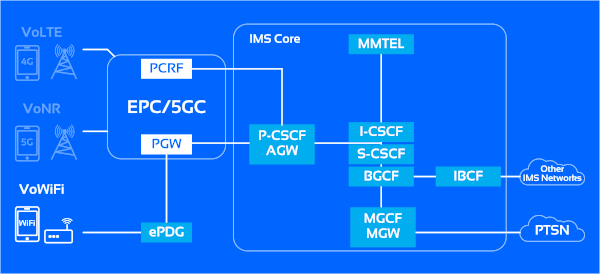
Figure 1: Voice over Wi-Fi (VoWiFi) network architecture.
VoWiFi: an alternative to over-the-top (OTT) voice providers
The benefits of VoWiFi to the end user seem straightforward. They can make calls in places with no mobile signal (e.g., in a property with thick walls), and they can do so without needing to install new software or establish new service relationships. If they care about such things, they know they enjoy the same SIM-based security they have when they are on the mobile network. Depending on their operator’s charging approach and their data and call plans, they can expect not to pay for at least some calls made over a Wi-Fi network. Seamless handover allows them to begin a call on Wi-Fi and keep it going as they transition to the public mobile network, or vice versa.
Network operators can provide better service to their customers without ramping up their radio access networks. They can continue to use core network elements to route, control, and bill for voice calls even when they are not providing the access technology. They get to keep traffic and interconnect revenues that might otherwise have been lost to them.
VoWiFi integrates the service with the security and interoperability provided by the mobile network. This allows for handover between Wi-Fi and the public mobile network and routing calls to telephone numbers. This makes it an attractive alternative for operators and end users to so-called “over-the-top” (OTT) voice providers like WhatsApp or Skype. These latter offer a telephony-like service over an operator’s data service. A wide variety of standalone apps and services can make end-to-end voice conversations over Wi-Fi networks. Still, all parties need to be on the same service and to be in some way “friends”, able to allow connectivity between them.
VoWiFi is, therefore, an important weapon in the operator’s arsenal of tools to compete with the OTT VOIP providers that are cannibalizing their voice revenues.
VoWiFi is a service whose time has come. The ubiquity of Wi-Fi at home and in other premises, the reduced in-building penetration of LTE and 5G, and the competition from OTT voice services, all make it attractive for mobile network operators to offer it.
Challenges
Some of the challenges in deploying VoWiFi are obvious. There’s less-than-perfect compatibility between devices, software, and Wi-Fi networks. Even with networks that apparently have bandwidth to spare, there are quality of service (QoS) issues, with many broadband providers delivering a network that works fine for streaming video but suffers when it tries to do anything that can’t tolerate delay.
In Wi-Fi networks with multiple access points, handover doesn’t always work or doesn’t work as expected. Online forums are full of users complaining about choppy audio, clipping, and echo, among other things. Sadly for operators, users may attribute shortcomings in voice quality to them rather than to the broadband network or the local Wi-Fi configuration.
Nonetheless, as Wi-Fi technology improves and broadband becomes more accessible, VoWiFi is expected to play an increasingly important role in enhancing user experience in voice services.
Architectural requirements for VoWiFi
Delivering standards-based, interoperable voice service over Wi-Fi appears at first sight to be a simple matter of using unlicensed spectrum to carry packetized voice. But as with the duck that seems to be resting placidly on the lake, there is a load of complex activity going on beneath the surface.
Key to the VoWiFi technology is a series of architectural elements, protocols, and interfaces that enable calls to be carried end-to-end across networks using different technologies and with different owners. The most important is the Evolved Packet Data Gateway (ePDG). This vital component enables connectivity between mobile networks and non-3GPP networks, such as public Wi-Fi, commonly used for offloading data and voice traffic. With the increasing number of Wi-Fi hotspots and the need for flexible mobile services, the ePDG is crucial in improving network coverage, security, and user experience.
The Evolved Packet Data Gateway (ePDG)
The ePDG is a network element designed for secure access and interworking between 3GPP networks (LTE/5G core) and non-3GPP networks (Wi-Fi). It acts as a security gateway, creating a secure connection from untrusted networks to the mobile core network. This connection is achieved through an IPsec tunnel, ensuring data is encrypted and protected from unauthorized access.
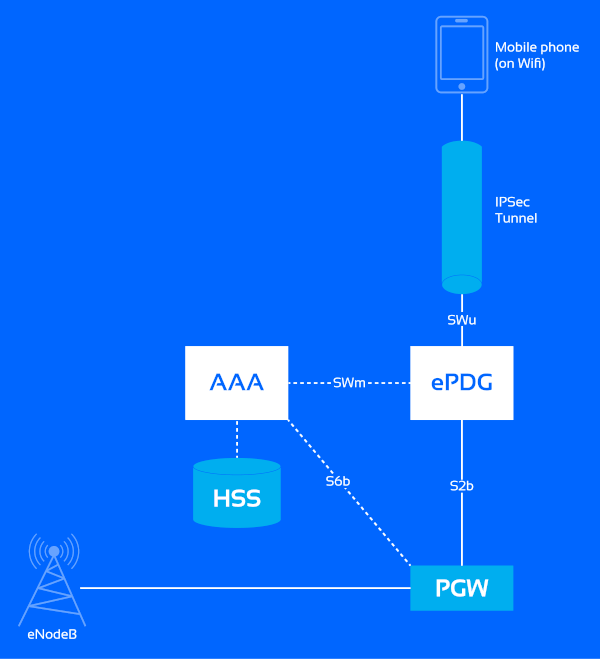
Figure 2: Secure handover between LTE/5G Core and Wi-Fi.
By enabling secure connectivity across networks, the ePDG significantly expands mobile networks' coverage and service potential. Notably, it allows service providers to:
- Extend their networks cost-effectively,
- Improve service accessibility in challenging areas (like in-building locations),
- Offer consistent, seamless connectivity,
- Enable high-speed, ultra-broadband services.
Operators who want to supplement LTE coverage by offering VoWiFi to their end-users must add an Authentication, Authorization, and Accounting (AAA) server and ePDG to the Packet Core and the IP Multimedia Subsystem (IMS). AAA are managed through a 3GPP-compliant AAA server, which validates user credentials and authorizes access. Subscribers can then use Wi-Fi to access the mobile operator’s core EPC network when LTE coverage is unavailable. The AAA server also acts to protect the network from potential cyberattacks.
How Does the ePDG Work?
The main components and processes involved in the operation of the ePDG are:
- IPsec tunnel establishment: When a device connects to a Wi-Fi network, the ePDG establishes an IPsec tunnel between the device and itself. This tunnel is essential for protecting data and ensuring a secure connection over non-3GPP networks. The IPsec tunnel is transparent to the Wi-Fi access point, meaning it doesn’t require special handling from the local network.
- SWu interface: This IPsec-based interface connects the WLAN (Wi-Fi) user equipment (UE) to the ePDG, ensuring data integrity and privacy.
- AAA server integration: Authentication, Authorization, and Accounting (AAA) are managed through a 3GPP-compliant AAA server, which validates user credentials and authorizes access. The ePDG uses the Extensible Authentication Protocol-Authentication and Key Agreement (EAP-AKA) method to authenticate users and establish a secure, encrypted session.
- Routing and packet management: Once the IPsec tunnel is established, the ePDG manages the routing of packets between the WLAN UEs and the Packet Data Network Gateway (PGW) within the mobile core. It supports both IPv4 and IPv6 configurations, enabling compatibility across various networks.
- Policy and quality enforcement: The ePDG enforces network policies, including Quality of Service (QoS) parameters, ensuring optimal performance and adherence to operator policies.
- Session continuity: For applications like VoWiFi, session continuity is vital. The ePDG supports seamless handoff, enabling users to move between Wi-Fi and cellular networks without interruption. This is achieved since the UE session is anchored at the PGW transparently via the ePDG—for the application (e.g., the IMS), the session simply originates from the PGW independent of access technology.
The ePDG beyond VoWiFi
While VoWiFi is one of the ePDG's most popular applications, its use cases extend far beyond voice services.
- Traffic Offloading
Operators can reduce congestion on their macrocellular networks by offloading traffic onto trusted and untrusted Wi-Fi networks. Wi-Fi provides a cost-effective alternative to boost coverage and relieve network stress in high-traffic areas such as shopping malls, airports, and stadiums. Trusted Wi-Fi networks, where the operator has control, can offer even more excellent service consistency by applying policies and managing traffic flow seamlessly.
- Seamless Network Integration and Session Handoff
The ePDG supports seamless session handoff between Wi-Fi and cellular networks, allowing users to maintain their data sessions as they move between network types. This capability is crucial in applications that require uninterrupted connectivity, such as video conferencing, streaming, and gaming.
For example, consider a user in a large shopping mall. As they move from outdoors (on LTE) to indoors (on Wi-Fi), the ePDG ensures that their session continues without interruptions, providing a consistent, high-quality experience.
- Network Security Services and Parental Controls
The ePDG can serve as a secure internet-traffic gateway, applying security policies and content filters. For instance, mobile operators can offer parental control services, allowing parents to filter inappropriate content for children on public Wi-Fi. Additionally, the ePDG enhances network security by blocking malware and unauthorized access, safeguarding users’ data from external threats.
- Backhaul Optimization
By utilizing existing Wi-Fi infrastructure for backhaul purposes, mobile operators can reduce costs associated with data transport. Offloading data-heavy applications like video streaming to Wi-Fi helps minimize the strain on LTE and 5G networks, allowing operators to use their backhaul resources more efficiently.
- Premium Content Delivery and Video Optimization
Operators can leverage the ePDG to offer premium services like video streaming and music playback. By connecting subscribers to operator-hosted content (like video and music libraries) through the ePDG, operators can deliver optimized, high-quality content without requiring users to switch networks. For example, a video streaming service could offer higher-resolution streaming on operator-owned Wi-Fi networks, ensuring an uninterrupted, superior viewing experience.
ePDG in Virtualized Networks
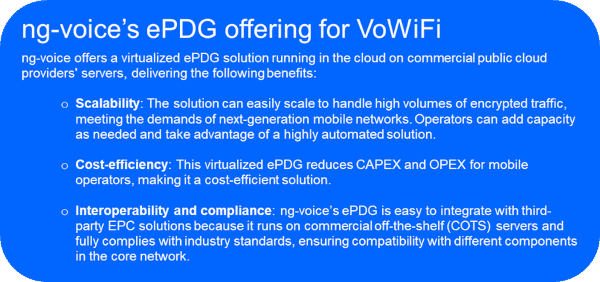
Virtualization has made it possible to deploy the ePDG as a software-based solution, reducing costs and offering greater flexibility than traditional, hardware-based solutions. Virtualized ePDGs can run on commercial off-the-shelf (COTS) servers and integrate easily with third-party EPC solutions. This virtualized deployment model allows operators to scale the ePDG efficiently and respond to the growing demand for secure, high-quality Wi-Fi services.
Conclusion
The ePDG is a fundamental component in modern mobile networks, bridging the gap between LTE/5G cores and non-3GPP networks like Wi-Fi. IPsec encryption, seamless session handoff, and robust authentication ensure secure, high-quality access for mobile users in various settings. From improving network security to enabling flexible service deployment, the ePDG empowers mobile operators to expand their reach and meet the growing demands for connectivity.
VoWiFi is a service whose time has come. The ubiquity of Wi-Fi at home and in other premises, the reduced in-building penetration of LTE and 5G, and the threat from “over-the-top” voice services, all make it attractive for mobile network operators to offer it. VoWiFi is an important tool in the operator’s armoury to compete with OTT VOIP providers such as WhatsApp or Skype.
As mobile traffic increasingly shifts to Wi-Fi, the importance of the ePDG will only continue to grow, especially with advancements in virtualization, which allow virtualized ePDG deployments to offer scalable, flexible solutions for the future.
Carsten Bock, Founder and Chief Innovation Officer at ng-voice, with 20+ years of experience in VoIP and IMS, Carsten led the development and implementation of the first IMS/ VoLTE platform at Telefonica in Germany and was a senior member of the Kamailio management team, developing the IMS extensions in Kamailio. He founded ng-voice in 2011 because he wanted to develop a flexible alternative to existing IMS solutions in the market. As Chief Innovation Officer, Carsten focuses his time on developing radical solutions to telco’s problems and pushing ng-voice’s innovation agenda.
About ng-voice
ng-voice is a Germany-based telco software provider, dedicated to revolutionising voice production in 4G/5G networks for both consumer and IoT use cases. Our flagship product - the Hyperscale IMS (IP Multimedia Subsystem) Solution - is infrastructure-agnostic, cost-efficient and fully automated. Being 100% containerised (with a container size of less than 25MB) and Kubernetes-based, our offering is ready to deliver VoLTE, VoNR and VoWiFi with up to 80% lower total cost of ownership (TCO), very fast deployment times and simplified lifecycle management. Whether you're a small operator or a Tier 1, ng-voice is the perfect partner to help you explore new revenue opportunities and future-proof your networks.
LinkedIn: ng-voice Contact: sales@ng-voice.com


