



During MWC Barcelona 2026, two Dutch technology companies will stand side by side at the Dutch pavilion that at first glance can easily be confused with one another: Radarxense and RadioSense. The names are very similar, and both work with radar waves and radio signals to make the physical world smarter. Yet their technology, applications, and market approach differ fundamentally.
What connects them is recognition: Radarxense won a Telecompaper Award, while RadioSense was awarded a TSOC Award. Together, they illustrate the breadth and depth of Dutch innovation at the intersection of telecom, sensing, and data intelligence.
Radarxense: infrastructure-driven radar for smart mobility
Radarxense focuses on a very concrete and urgent problem within mobility and infrastructure: traditional traffic detection is expensive, invasive, and difficult to scale. Induction loops require road closures and excavation work, while camera-based systems have limitations in bad weather and are sensitive from a privacy perspective. Radarxense therefore developed fully non-invasive IoT radar systems with ultra-low energy consumption that can be installed on existing infrastructure within thirty minutes.
The strength of Radarxense lies in the combination of hardware and cloud. The radars collect rich, multidimensional traffic data: including vehicle, bicycle, and pedestrian flow, while processing and algorithmic improvement take place entirely in the cloud. This makes the system scalable and future-proof. With an average energy consumption of less than one watt, the sensors can even operate autonomously via solar power.
Strategically, Radarxense positions itself explicitly toward the future of telecom. The company is active within the Dutch FNS 6G consortium and works on Joint Communication and Sensing (JCAS), in which future mobile networks themselves take on sensing tasks. The Telecompaper Award underscores Radarxense’s role as a technological bridge builder between physical infrastructure and telecom networks.
RadioSense: Wi-Fi as a privacy-friendly sensing layer
Where Radarxense focuses on outdoor spaces and mobility, RadioSense concentrates on indoor environments such as healthcare institutions, buildings, and secure spaces. The young company, founded in 2024, develops device-free sensing based on Wi-Fi radio signals. Without cameras, wearables, or wired sensors, RadioSense detects presence, movement, fall incidents, and anomalous behavior.
The fundamental distinction lies in the approach: RadioSense aims to transform existing Wi-Fi networks into an intelligent sensing layer. When physical Wi-Fi (PHY) data is available, the system operates fully software-based. If that is not possible, RadioSense deploys compact proprietary devices to create a dedicated radio environment. All data is processed locally with explainable AI, which guarantees full GDPR compliance.
The applications are broad: from fall detection in elderly care and presence signaling for energy savings in buildings to early anomaly detection for security. The inspiration behind RadioSense is both societal and personal. Founder Fabian van Prooijen was personally motivated by caring for his 97-year-old grandfather and by the structural shortcomings of existing, often invasive monitoring systems. With this motivation, he found co-founder Jeroen Klein Brinke, an expert in RF sensing based on his PhD research into Wi-Fi-based detection and signal analysis. From a shared mission to deploy technology for positive societal impact, they translate scientific depth and personal drive into a privacy-conscious sensing solution. The TSOC Award thus recognizes RadioSense as a promising deeptech player in responsible, future-oriented sensing.
How to remember the difference
Radarxense measures the outside world: traffic, infrastructure, and mobility, with hardware-driven radar and cloud intelligence.
RadioSense understands the inside world: people, movement, and safety, via Wi-Fi signals and local AI.
Both companies work with radio waves, but their focus, scale, and impact differ fundamentally. Together, they show how broadly sensing can be applied within telecom-driven ecosystems.
European innovation with international ambition
What Radarxense and RadioSense share is their international ambition and European approach to technology: energy-efficient, privacy-focused, and designed for integration with existing infrastructures. During MWC Barcelona, both actively seek collaboration with telecom operators, technology partners, integrators, and investors to scale pilots and enter new markets, particularly in Northwestern Europe and beyond.
For organizations interested in smart, sustainable, and future-proof sensing solutions, a visit to Radarxense and RadioSense during MWC 2026 is therefore highly worthwhile. Their technologies show how Dutch innovation is redefining different facets of sensing, from infrastructure to healthcare.
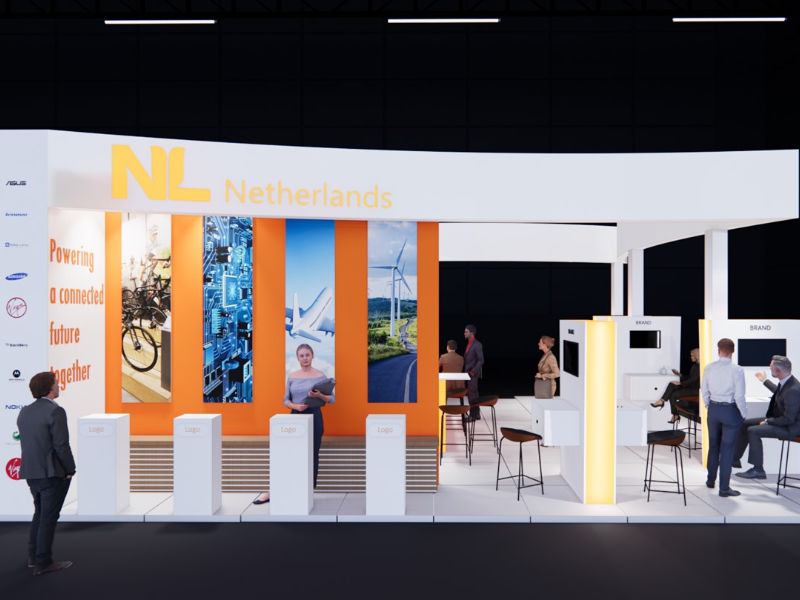
You can find both companies in the Netherlands Pavilion during MWC Barcelona from 2–6 March 2026. RadioSense can also be found in the 4YFN area of the Mobile World Congress.
Would you like to learn more about the NL program during MWC Barcelona 2026 or join the Dutch delegation, including access to MWC Barcelona? Visit NLMWC.com or contact Anke Kuipers via anke@ecosystemservices.nl.


