At Data Centre World (DCW) Singapore 2026, David AN, Director of ZTE CTO Group, delivered a keynote titled "From Data Center to AI Factory, TCO-Optimized AIDC" in the DCW Keynote Theatre. The presentation outlined how the explosive growth of AI is transforming data centers from traditional facilities into integrated AI factories, and why the industry must optimize the entire AI factory lifecycle - not individual components—to achieve sustainable total cost of ownership (TCO).
AN opened by highlighting the rapid acceleration of global computing demand. Inference now drives 70% of intelligent computing growth, while global daily token usage has increased by 1,000 times in just two years. By 2032, global data center scale is projected to reach 246 GW, with AI data centers (AIDC) accounting for 52% of that capacity. This surge is placing unprecedented pressure on power, cooling, architecture, and deployment.
"AI is pushing traditional data center architecture to its limits," said David AN. "The industry must restructure power systems to dynamically match load demand, reduce transmission loss, and rethink how compute, power, and cooling work together."
The presentation identified three industry trends
1. Power Becomes the New Bottleneck. Data center power is evolving from a single grid input to multi-energy synergy and generation-storage-distribution-consumption linkage. The system must match power with computing load in real time across day/hour, hour, minute, second, and millisecond levels. Technologies such as 800V HVDC, solid-state transformers (SST), and multi-level energy storage are essential.
2. Cooling Must Follow Compute Density. Low-density data halls (≤40 kW) can rely on air cooling with PUE ≤1.25. High-density halls (60–240 kW) require air-liquid hybrid cooling with PUE ≤1.15. Ultra-high-density AI halls (≥600 kW) demand full liquid cooling with PUE ≤1.09. Cooling must evolve alongside chip and rack trends to support the next generation of AI workloads.
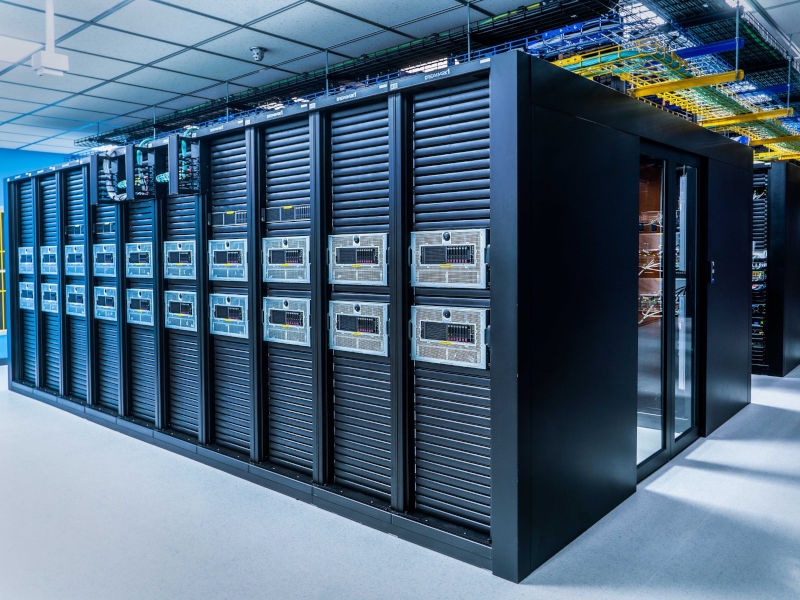
3. AI Infrastructure Must Evolve at GPU Speed. Traditional site-assembled construction is too slow. The industry is moving toward modularity and prefabrication, full-unit transport, on-site assembly, and joint commissioning. With 90% MEP modularization, delivery periods can be reduced by 50%. This approach also enables phased investment, synchronized power and cooling matching, and sustained technology roadmap evolution.
ZTE's vision is to optimize the AI factory as one system that integrates the co-design and coordination of computing, power, and cooling. This system is characterized by synergy management, energy saving, flexible adaptability, and rapid delivery. ZTE's end-to-end AI infrastructure capabilities span power, cooling, and prefabricated data centers. Key solutions include 800V HVDC power modules, safe lithium batteries, intelligent busbars, cold-plate and immersion liquid cooling, fan walls, and fully prefabricated data centers.