


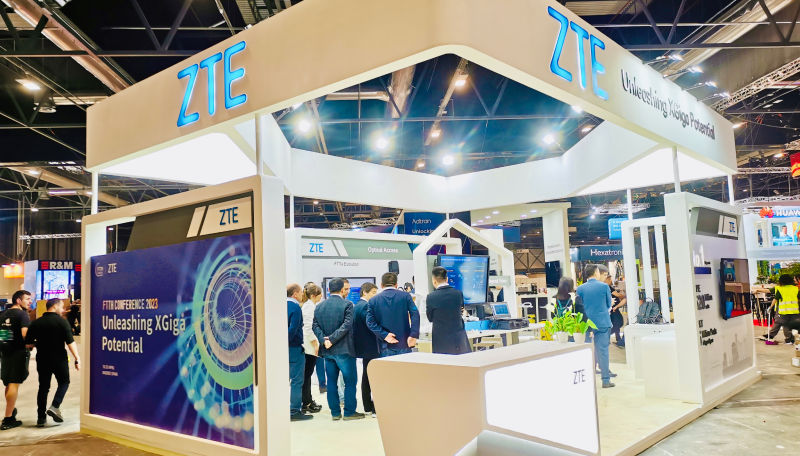
During the last edition of the FTTH conference held in Amsterdam, Telecompaper spoke with Mr. Hu Junjie (Peter Hu), Vice President of ZTE, about ZTE’s vision for next-generation access technologies. With 50G PON deployments live in markets such as Italy, Egypt, and Turkey, and AI-powered innovations reshaping in-home connectivity, Peter Hu shared how ZTE is helping operators evolve their infrastructure efficiently, intelligently, and with the future in mind.
ZTE is already actively rolling out 50G PON in several regions. What makes this solution compelling for operators now?
Peter Hu: The key is continuity. From 1G to 10G to 50G PON, we’ve ensured a smooth upgrade path without changing the Optical Distribution Network (ODN). Construction of ODN is often labor-intensive and expensive, especially in urban areas. By maintaining compatibility with legacy infrastructure, operators avoid major overhauls.
We’ve also improved operational efficiency. Our systems offer full visibility into passive components of the network. That means easier fault detection and resolution, and a smoother path toward self-healing, automatic networks—something our customers are increasingly asking for.
Let’s talk about CAPEX and OPEX. How is ZTE helping operators on both fronts?
Peter Hu: First on CAPEX, we lead the market with high port-density platforms. Our 16-port symmetrical 50G PON Combo board is the highest-density solution available. It also supports coexistence with GPON and 10G PON, enabling operators to gradually phase in upgrades without replacing everything at once.
On the OPEX side, it’s all about WiFi performance. Customers don’t complain about PON—they complain when their WiFi drops. That’s why we developed AI-powered heatmaps, smart antennas, and in-home diagnostics tools that allow operators to monitor and troubleshoot routers remotely.
So, performance inside the home is just as important as the core network?
Peter Hu: Absolutely. The last meter is where customer satisfaction is won or lost. In addition to WiFi 7, we’re working on WiFi 8. WiFi 8 isn’t just fast—it’s intelligent. For example, in our AI-enabled smart home solution, the WiFi signal itself can detect if someone has fallen at home. If the system detects abnormal body posture—say, lying on the floor—a robotic camera is dispatched, enabling remote caregivers to check in without requiring 24/7 video monitoring. It’s a breakthrough in privacy-conscious elder care.
This next generation supports laser-based satellite backhaul, which allows remote point-to-point connections, and in some cases may even replace traditional 6G concepts.
That’s a fascinating use case. What other applications are emerging from your AI platform?
Peter Hu: We’re seeing exciting innovation in home entertainment and storage. For instance, our gesture-recognition capabilities allow users to control games or media with motion, like a next-gen Nintendo Wii. Another key feature is AI-powered NAS storage—instead of uploading your photos to the cloud, they’re stored locally in the home, reducing latency and improving privacy.
We’ve integrated Deepseek, an open-source AI engine, directly into our Customer Premises Equipment (CPE). Operators can build their own private clouds and layer on custom AI services. This shifts the value chain back toward the Telco, empowering them to offer services that today are dominated by OTT players like Google or Alibaba.

How is ZTE supporting these developments at the network architecture level?
Peter Hu: Traditionally, Telcos used ring topologies for their core networks—solid, but inflexible and expensive. We’re now seeing a shift toward data center-inspired, star-topology designs that allow for greater agility and cost efficiency.
We also bring IP and optical synergy into our core transport solutions. That reduces equipment layers, simplifies operations, and boosts performance. With our experience in 4G/5G backhaul, and now in fixed access, we’re helping operators create unified architectures that work from the data center all the way to the living room.
Let’s return to 50G PON for a moment. What’s the timeline for mass-market deployment?
Peter Hu: Initially, 50G PON is geared toward B2B applications—think VR in education or high-res surveillance in SMEs. That’s where the bandwidth is needed today, and where WiFi limitations are less of a bottleneck.
But we expect a broader shift—the “50G/XGS flipping point”—between 2026 and 2028. As WiFi 8 and in-home infrastructure improve, consumer use cases will catch up. Operators need to prepare now so they’re ready to scale when the time comes.
What’s your final message to operators considering their next steps in fixed access and in-home networking?
Peter Hu: Look for solutions that are evolutionary, not disruptive—like our backward-compatible 50G PON. Focus on OPEX optimization through intelligent WiFi management. And don’t overlook the strategic potential of AI in the home. With platforms like Deepseek and flexible FTTR solutions, operators can take back control from OTTs and offer unique, customer-centric experiences.
The network is no longer just a pipe—it’s a platform for innovation. ZTE is here to help operators build smarter, leaner, and more valuable networks for the future.


