



Streaming services in the Netherlands are mainly purchased by households with children, according to the Telecompaper Video Behavior of Dutch consumers report for the second quarter. Households with children were the most important growth engine for Disney+, Videoland, Amazon Prime Video, Netflix and other services. Amazon's service also appeared to be relatively often combined with other services. Disney+ viewers indicated that they mainly consume children's content, more often than subscribers to other services. Young people under the age of 35 seemed to watch more online content than average. This was mainly at the expense of live TV viewing time, which was higher among older age groups.
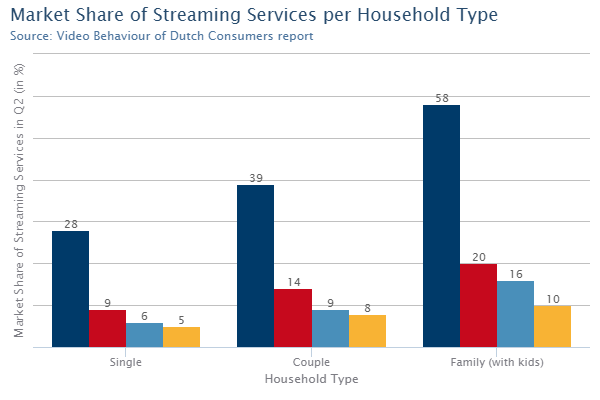
With all major streaming services, we see that households with children purchased a subscription more often than households without children. Over half (58%) of Dutch households with children had a Netflix subscription, against a market average of 42 percent. We also saw the same trend for Dutch Videoland: 20 percent of households with children had a subscription to Videoland, against 15 percent of all Dutch households.
Amazon Prime records largest increase, often combined
Amazon Prime Video gained ground over the past year: it more than doubled its share, rising to 8 percent from 3 percent of the market among households with a streaming subscription. The service gained market share in all types of households, but growth was greatest among households with children.
Other major services, such as Netflix, Videoland and Disney+, also saw a year-on-year increase in market share. In these services too, the year-on-year lift was mainly due to households with children. Smaller services, such as Apple TV+, NLZiet and Discovery+, also saw a slight increase, but not enough to go up by 1 percentage point in market share.
Amazon seems to have benefited in particular from the growth in stackers, people who combine multiple streaming services. At the end of June, 24 percent of households had a subscription to more than one streaming service, 5 percent more than the year earlier.
Amazon Prime Video appears to be combined at an above averagerate: 85 percent of households that had Amazon Prime Video also had a subscription to Netflix.There are several possible explanations for Amazon’s success. The price of Amazon Prime (EUR 3 per month) is relatively low, which reduces the threshold for purchasing this service alongside another services. In addition, people get several other benefits with Prime, such as free shipping on selected products from the webshop.
Disney+ viewers watch a lot of children's content
For Disney+ users, children's content is relatively important: 17 percent of Disney+ customers said they mainly watch children's content on this service, much more than, for example, on Netflix, Videoland (both 5%) and Ziggo Movies & Series (7%). Disney is hoping also to attract adults with the launch of its Star service within Disney+. Star has been live in the Netherlands since February.
Young people watch a relatively large amount of content via the internet
Young people watched a relatively large amount of content via the internet: users under the age of 35 spent more than half of their viewing time on online content (TVoD, SVoD, content on the internet such as YouTube). Together, young people watched online content for more than 2.5 hours a day. This was mainly at the expense of the viewing time of live TV. The viewing time of live television was higher among older groups: while young people aged 16-25 watched live TV for 44 minutes a day, 67-80 year-olds did so on average for more than 2.5 hours per day.


