


T-Mobile Netherlands will this week activate its Internet-of-Things network in a number of cities. From next week, the NB-IoT network will be available in Amsterdam, Rotterdam, The Hague, Eindhoven and in the area around Schiphol. More locations will follow next month and next year, with nationwide coverage in the course of 2017. T-Mobile NL claims to be the first to roll out NB-IoT on such a large scale.
The mobile operator wants to further explore IoT with its customers and partners and see what interesting applications could be tested on the new network. Itho Daalderop, Dual Inventive and Smart Sensors are among the first group of companies to test their IoT applications with NB-IoT. In the past few months, T-Mobile NL has invited initiatives from the market. It will continue to do so. Anyone with concrete plans can test their application on the NB-IoT network in the Netherlands, by sending an application to the company from 20 October. Telecompaper noted this was a developing trend, as Vodafone also operates in this way on an international scale.
Richard Marijs, technology strategist at T-Mobile NL, said: "T-Mobile NL has very deliberately chosen NB-IoT because the technique uses its own licensed frequency spectrum. As a result, for example, there will be no question of interference with other signals. In addition, NB-IoT can relatively easily be activated on our existing network, by making use of the 900MHz band which is also used for 4G. So we will be able to have a nationwide NB-IoT in a short time."
In June, NB-IoT standards on 4G networks were approved by the 3GPP as the standard for IoT on mobile networks. The standard was developed in collaboration with twenty parties worldwide, including Deutsche Telekom and Huawei. Telekom said it was also starting NB-IoT in Germany, where it already has test environments at the Narrowband IoT Prototyping Hub in Bonn, as well as at its hub:raum facilities in Berlin and Krakow. Developers working at the sites are expected to deliver the first applications by the end of 2017.
Deutsche Telekom and Huawei also are jointly introducing the Narrowband IoT Soft Lab concept in order to accelerate development of the NB-IoT ecosystem. Soft Labs are an evolution of the existing Open Lab concept, where physical labs were set up at various locations around the globe, so hardware (chipset/module) manufacturers and application developers can come together to perform end-to-end testing. With the introduction of Soft Labs, developers based anywhere in the world can test chipset, module and base station functionalities without physical installation, by using software operating on a standard PC. The only prerequisite is connectivity to the virtusalised core network and IoT platform.
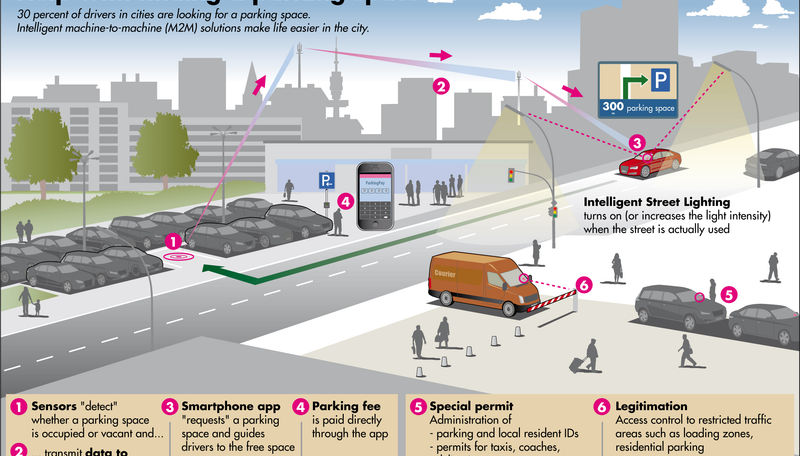
The first commercial application using the platform in Germany is a smart parking system in Bonn. Sensors built into each parking space connect to the 4G network in order to communicate with motorists via an app that directs them to available parking spaces.


